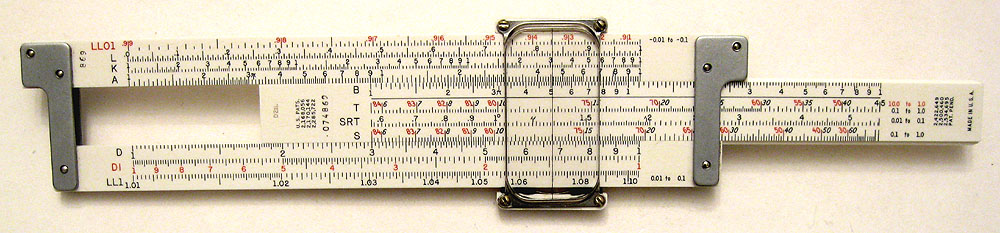
Logs of Arbitrary Base by LL Scales

Man, those LL scales; they really are something! In the last two installments, we saw how they could be used to find natural logs and powers of e. Yeah, pretty cool, but how 'bout using them to determine logarithms of any legal base! That'll be the thrust of this section. Very powerful, indeed...

Now, a bit about the notation. I'm not really sure how to do subscripts decently on a Web site like this, so I'll use the following schema:

log(b, x)

to mean "the logarithm base b of x." So, for example, log(4, 16) = 2 should be read as "the logarithm, base 4, of 16 is equal to 2." This, of course, implies that 4^2 = 16, as usual.

To get started, let me describe how to find such a logarithm, stating the steps as baldly as possible. Then we'll take a look at the machinery that makes it work.

To find log(4, 16):
  1. Set the cursor at 4 on the LL3 scale.
  2. Align the left index with the hairline.
  3. Move the cursor to 16 on the LL3 scale.
  4. Read the result, 2, under the hairline on the C scale.
That was mighty efficient, wasn't it! But how on earth does it work? Examine the following figure:

Click to enlarge

Think of this as a multiplication problem, using the canonical approach we learned in the very first tutorial here:

The left index (C:1) is aligned with 4 on the LL3 scale, but notice that this corresponds to about 1.386 on the D scale. In other words, we've just set things up to multiply by ln(4) ≈ 1.386.

Next, suppose we wanted to multiply that number by 2. Observe that the cursor has been moved rightward until it aligns with 2 on the C scale. 2, of course signifies log(4, 16), which strictly speaking we're not supposed to know yet. But stay with me...

Under the hairline, on the D scale is a result of 2.773. But this length maps to ln(16) on the LL3 scale.

Putting these segments all together, still thinking of the total arrangement as a multiplication problem:

ln(4) * log(4, 16) = ln(16)

Rearranging the relationship, we arrive at:

log(4, 16) = ln(16) / ln(4)

Aha! The old change-of-base gambit!

The method sketched out above is not only legitimate, but it works slick as hell. Let's see it in action.

Exercise 1.1: Find log(8, 37).

Both numbers here (the base 8 and the argument 37) appear on the LL3 scale.
  1. Set the cursor to 8 on the LL3 scale.
  2. Align the left index with the hairline.
  3. Move the cursor to 37 on the LL3 scale.
  4. Read the result under the hairline on the C scale: 1.74.
Remember that many slide rules, like the K+E 4181-1 I'm using here, label the right side of the scales with reminders. In this case, we see that the result should lie between 1.0 and 10.0, which in any event jibes with a quick estimation. Here's how it appears (again, click the photo if you want to see it full-sized):


Cursor to LL3:8, left index to hairline, cursor to LL3:37, result at C:1.74

Of course, we can use the other LL scales for smaller arguments.

Exercise 1.2: Find log(5, 1.5).
  1. Set the cursor to 5 on the LL3 scale.
  2. Align the left index with the hairline.
  3. Move the cursor to 1.5 on the LL2 scale.
  4. Read the result under the hairline on the C scale: 0.252.
The label on the rule reminds us that the result should lie between 0.1 and 1.0. In passing, I'll ask you to note the base is on the LL3 scale, the argument on the LL2 scale (one notch lower), with the result one order of magnitude smaller than that arrived at in Exercise 1.1. I'll explain in more detail later, but for now, whenever you skip from one LL scale to an adjoining one, the magnitude changes accordingly.

Graphically, we have:

Cursor to LL3:5, align left index, cursor to LL2:1.5, result at C:0.252

Let's try one with an even smaller argument. On my K+E here, I'll need to do a duplex-flip, since LL1 is on the reverse side of C. (Most slide rules tend to put two of the LL scales on one side, with the third opposite that).

Exercise 1.3: Find log(20, 1.07).
  1. Set the cursor to 20 on the LL3 scale. This is the base, of course.
  2. Align the left index with the hairline.
  3. Move the cursor to 1.07 on the LL1 scale.
  4. Read the result under the hairline on the C scale: 0.0266.
An order of magnitude smaller than the previous problem, but thanks to the helpful labels on the K+E 4181-1 slide rule, we knew that was coming. As mentioned, a couple duplex-flips are required (C and LL1 are on opposing sides), so it'll take three pictures to show it all:


Cursor to LL3:20, left index to hairline, duplex-flip
Cursor to LL1:1.07, duplex-flip
Result at C:0.0266

We should really try a couple problems in which the base is less than e, and hence needs to be located on LL2 or LL1.

Exercise 2.1: Find log(1.5, 48).
  1. Set the cursor to 1.5 on the LL2 scale.
  2. Align the right index with the hairline.
  3. Move the cursor to the 48 on the LL3 scale.
  4. Read the result under the hairline on the C scale: 9.55.
In summary:

Cursor to LL2:1.5, align right index, cursor to LL3:48, result at C:9.55

Did you see the right index coming to keep from going off-scale? This requires a mental adjustment, but it's simple enough to accommodate. With the base being located on the LL2 scale, we expect to interpret the C scale as 0.1 to 1.0. However, by using the right-index, we are instead thinking of the result being off to the imaginary right of the slide-rule, i.e., the next order of magnitude up. So, it's 9.55 and not 0.955.

This might be a good time to mention that the LL scales, though tripartite, really should be thought as connecting to each other, yielding one triple-length scale: LL1 + LL2 + LL3.

Exercise 2.2: Find log(1.2, 1.7).

In this problem, both b and x lie upon the LL2 scale. That'll be important to remember in just a moment.
  1. Set the cursor to 1.2 on the LL2 scale.
  2. Align the left index with the hairline.
  3. Move the cursor to 1.7, also on the LL2 scale.
  4. Read the result under the hairline on the C scale: 2.91.
In pictures,

Cursor to LL2:1.2, align left index, cursor to LL2:1.7, result at C:2.91

You may have been expecting 0.291, since we were using the LL2 scale. I mean, that's how we mentally adjusted things in Exercise 1.2. Here's the deal. It's only when "crossing boundaries" that the order of magnitude changes. In Exercise 1.2, we had the base, b, on the LL3 scale, but the argument, x, on the LL2 scale.

The general rule is: C maps to the range 1.0 to 10.0 when both b and x are on the same LL scale. But if x is located on a scale lower than that on which b lies, then the order drops.

Read over the following relationships and think about them for a moment. There's actually nothing to memorize since the pattern is fairly obvious.

LL3:b, LL3:x ---> 1.0 to 10.0
LL2:b, LL2:x ---> 1.0 to 10.0
LL1:b, LL1:x ---> 1.0 to 10.0

LL3:b, LL2:x ---> 0.1 to 1.0
LL3:b, LL1:x ---> 0.01 to 0.1

LL2:b, LL3:x ---> 0.1 to 1.0

We just seen what happens when we "drop" from one LL scale to the next below. And, of course, you can reverse gears as well and move upward.

To frame this in words, C is expected to give values of logarithms between 1.0 and 10.0. But, when moving from one LL scale for b, to the next higher adjacent one for x (say, going from LL1 to LL2) the order of magnitude is bumped up a notch, 10.0 to 100.0. Similarly, going from LL1 to LL3 puts you in the 100.0 to 1000.0 range. And clearly when moving downward (LL3 to LL2 to LL1), you'll decrement the order of magnitude, as we just saw.

Naturally, you'll also need to take into account whether you used the right index, as in Exercise 2.1. That has the effect of shifting things one way or another as well.

That may all sound messy, but trust me: sit quietly, work a few examples and look for the patterns; it'll quickly make eminent sense, I promise!

Powers of e with the LL Scales

In the last installment, we learned how to compute natural logarithms by means of the LL (log-log) scales. It's a simple matter to turn that method around and come up with e raised to any power. I urge you to review that episode, especially the figure illustrating the the domain and range of ln(x) and how they're apportioned over the LL and D scales.

The rules for finding e^x are quite simple:
  • The argument is always indicated on the D scale.
  • The D scale may represent 1.0 through 10.0, 0.1 through 1.0, -0.01 through -0.1, etc., depending on the argument.
  • The resulting value is always found on one of the LL scales (LL1, LL2, LL3, LL01, LL02 or LL03).
  • The scale to use is determined by the size of the argument.

You might think it would be tricky to know how to interpret the number on D or how to determine which LL scale to use, but it's not. Most slide rules print helpful reminders right on the rule. Here's how my K+E 4181-1 does it:

Click any photo to enlarge

Here, at the bottom, we see that the LL1 scale is meant to be used with arguments ranging from 0.01 to 0.1 (as indicated on the D scale by 1.0 to 10.0).

At the top, we further note that arguments spanning -0.01 to -0.1 are associated with values on the LL01 scale.

On the flip-side of this duplex rule, we find:


LL2 (at the bottom) corresponds to arguments in the 0.1 to 1.0 range, while LL3 (second from the bottom) goes with 1.0 to 10.0. Likewise, LL02 (top) is for arguments from -1.0 to -0.1, and LL03 (second from top) for -10.0 to -1.0.

And remember, the LL scales for negative arguments read right-to-left. With that, let's tuck into some exercises.

Positive Arguments


Exercise 1.1: Compute e^3.7.
  1. Set the cursor to 3.7 on the D scale.
  2. Read the result under the hairline on the LL3 scale: 40.5.
In summary:

Cursor to D:3.7, result at LL3:40.5

Exercise 1.2: Compute e^7.
  1. Set the cursor to 7 on the D scale.
  2. Read the result under the hairline on the LL3 scale: 1100.
Here's what it looks like:

Cursor to D:7, result at LL3:1100

In the next problem, we switch to the LL2 scale because the argument lies between 0.1 and 1.0, as the label on the slide rule reminds us.

Exercise 2.1: Compute e^0.19.
  1. Set the cursor to 0.19 (1.9) on the D scale.
  2. Read the result under the hairline on the LL2 scale: 1.21.
Graphically, we have:

Cursor to D:0.19, result at LL2:1.21

Are you getting the hang of it? The next problem drops another order of magnitude lower.

Exercise 3.1: Compute e^0.065.
  1. Set the cursor to 0.065 (6.5) on the D scale.
  2. Read the result under the hairline on the LL1 scale: 1.0672.
In pictures:

Cursor to D:0.065, result at LL1:1.0672

Negative Arguments


The reverse-reading LL01, LL02 and LL03 scales are employed when the argument is less than zero.

Exercise 4.1: Compute e^-0.025.
  1. Set the cursor to -0.025 (2.5) on the D scale.
  2. Read the result under the hairline on the LL01 scale: 0.9753.
Summarizing the steps:

Cursor to D:-0.025, result at LL01:0.9753

Exercise 4.2: Compute e^-0.42.
  1. Set the cursor to -0.42 (4.2) on the D scale.
  2. Read the result under the hairline on the LL02 scale: 0.657.
Pictorially:

Cursor to D:-0.42, result at LL02:0.657

Exercise 4.3: Compute e^-3.9.
  1. Set the cursor to -3.9 (3.9) on the D scale.
  2. Read the result under the hairline on the LL03 scale: 0.02.
And it looks like this:

Cursor to D:-3.9, result at LL03:0.02

You should have had no trouble determining which scale to use with any of these, especially if your slide rule sports the reminder ranges on the side of each.

Now even if you don't expect to need natural logs or exponentials, as covered in this and the previous installment, this has all been worth learning for what's to come next: computing arbitrary roots and powers. I think you'll be amazed at what's possible, once you understand the ranges of the LL scales.

Next installment: Logs of Arbitrary Base by LL Scales

Natural Logs with the LL Scales

Okay, we're really going to up the amperage now by switching over to a more endowed engineering type slide rule that'll make short work of natural logs and exponentials. You'll need a rule featuring the so-called LL (log-log) scales.  I'll be using a Keuffel & Esser (K+E) 4181-1 pocket slide rule, simply because I think it's cute and easy on the eyes. But there are many other units at your disposal.

You can actually perform a plentitude of surprising operations with the LL scales, but the best way to master the broad range of what's possible is by first focusing simply on how to use them to compute natural logarithms. In that way, you'll become comfortable with the various intervals at the outset and learn exactly which scale to reach for and when.

Overview of the LL Scales


Recall that the natural log function, ln(x), has domain of all positive reals, and range of all reals. Moreover, the domain splits into two distinct portions: logs of arguments less than 1 are negative, while those greater than 1 are positive.

One other thing: the values of the log function (even though it grows without bound), bunch up as the argument increases. Thus, slide rule manufacturers have seen fit to apportion various subranges over several scales rather than try to cram everything into a single length. On the K+E I'm using which is about 6" long, there are LL1, LL2, LL3, LL01, LL02 and LL03 scales. Juxtapose them all and you've got the equivalent of a 36" slide rule!

Now the most important to learn right away is that the argument, x, is always pinpointed on one of the LL scales, and the result, ln(x) will always be found on the D scale. We recall that D spans 1.0 to 10.0, however when used to output natural logs, we interpret the order of magnitude, so it might mean 0.1 to 1.0, or -10.0 to -1, etc. You'll find this is all quite easy to keep in mind. Furthermore, on my K+E, the manufacturer has even etched the various ranges on the right side of the scales. Nothing to memorize! Refer to the following figure:

Click to enlarge.
Let's begin on the right and work backwards. You'll note that arguments for ln(x) span about 2.718 to 20,000 on the LL3 scale. In this portion of the domain, the range covers 1.0 to 10.0 which is measured on the D scale as always. You no doubt recognize 2.718 as the slide rule's approximation to e, and clearly ln(e) = 1.0.

Move back a notch. If the argument lies between 1.105 and 2.718, now on the LL2 scale, then the associated functional values span 0.1 to 1.0. Again, these are found on the D scale but mentally interpreted to be one order of magnitude less than before. That's not hard to remember, but it's nice that K+E printed that range as a reminder next to the LL2 scale.

Drop lower again. If the argument lies between 1.01 and 1.105 on the LL1 scale, then the associated functional values span 0.01 to 0.1 on the D scale. Are you starting to get comfortable with the pattern?

Now when the argument gets really close to 1.0 on either side, then the logarithm becomes exceedingly tiny and close to 0. So, we pass over that dead region of 0.99 to 1.01. The idea here is that for most engineering application, anytime you're computing the natural logarithm of a number between 0.99 and 1.01, that result is so near 0, it becomes negligible. However, for the fastidious, hang on a few moments, and we'll see some slide rules feature an LL0 scale really allowing you to split hairs.

Continuing our leftward migration in the figure above, the next subrange is 0.905 to 0.99 on the LL01 scale, and it maps to -0.1 to -0.01 on the D scale, after a suitable mental translation for the order of magnitude.

Similarly, arguments between 0.0368 to 0.905 on LL02 go to -1.0 to -0.1 on D.

Finally, 0.0000454 to 0.0368 on the LL03 scale map to -10.0 to -1.0 on the D scale.

In short, we can directly find natural logarithms of arguments from 0.0000454 all the way to 20,000, with a brief timeout when very close to 1. I urge you to study the figure once again and look for how LL03+LL02+LL01 along with LL1+LL2+LL3 are in effect gigantic scales.

With regard to arguments near 1.0, in my collection the Post Versalog 1460 and Faber-Castell 2/83N both sport LL0 and LL00 scales that let you zero in even closer on ln(1) = 0.

A Recap and a Few Extra Details


These are really easy to use, so don't let my long-winded explanation put you off. Nonetheless, a brief summary might be useful just now. And I'll mention a couple other things I passed over above for simplicity.

When computing natural logarithms with the LL scales:
  1. The argument is always specified on an LL scale.
  2. The value is always found on the D scale, with the order of magnitude mentally set.
  3. Most slide rules inidicate the associated order of magnitude next to each LL scale.
  4. The LL1, LL2 and LL3 scales are for arguments greater than 1.
  5. The LL01, LL02 and LL03 scales are for arguments between 0 and 1. They read right-to-left and are typically printed in red. Moreover, the value of ln(x) on any of these three scales is negative.
With that, let's work some problems!

Exercise 1.1: Compute ln(13.7).

The argument is greater than 2.718 (e), so we must be using LL3.
  1. Set the cursor to 13.7 on the LL3 scale.
  2. Read the result under the hairline on the D scale: 2.62. No mental adjustment for order of magnitude is required.
Here's how it looks on my K+E 4181-1:

Cursor to LL3:13.7, result at D:2.62

Exercise 1.2: Compute ln(225).
  1. Set the cursor at 225 on the LL3 scale.
  2. Read the result under the hairline on the D scale: 5.42.
Pictorially:

Cursor to LL3:225, result at D:5.42

Exercise 1.3: Compute ln(1570).
  1. Set the cursor at 1570 on the LL3 scale.
  2. Read the result under the hairline on the D scale: 7.36.
And this is what it looks like:

Cursor to LL3:1570, result at D:7.36

Though covering a fairly broad range of arguments, all three of these problems only required LL3 and D. Let's get used to the other scales now.

Exercise 2.1: Compute ln(2.5).

Aha! Something less than e, so we drop down to the LL2 scale.
  1. Set the cursor at 2.5 on the LL2 scale.
  2. Read the result under the hairline on the D scale, and interpret one order of magnitude less: 0.92.
In summary:

Cursor to LL2:2.5, result at D:0.92

Exercise 3.1: Compute ln(1.05).

We're creeping close to 1 now. Time to go to the LL1 scale.
  1. Set the cursor at 1.05 on the LL1 scale.
  2. Read the result under the hairline on the D scale and mentally adjust for two orders of magnitude smaller: 0.0488.
Graphically:

Cursor to LL1:1.05, result at D:0.0488

We need to see some problems in which the logarithm drops below the x-axis.

Exercise 4.1: Compute ln(0.94).

The argument is below but reasonably close to 1, so we'll require the LL01 scale.
  1. Set the cursor at 0.94 on the LL01 scale.
  2. Read the result under the hairline on the D scale, mentally adjust for the order of magnitude, and prefix with a minus sign: -0.062.
Here's what I see:

Cursor to LL01:0.94, result at D:-0.062

Exercise 4.2: Compute ln(0.52).
  1. Set the cursor at 0.52 on the LL02 scale.
  2. Read the result under the hairline on the D scale, interpret the order of magnitude and negate: -0.654.
In pictures:

Cursor to LL02:0.52, result at D:-0.654

Exercise 4.3: Compute ln(0.17).
  1. Set the cursor at 0.17 on the LL03 scale.
  2. Read the result under the hairline on the D scale, interpret the order of magnitude and negate: -1.77.
Here's how it goes:


Cursor to LL03:0.17, result at D:-1.77

And that's a wrap! I don't know if you suffered through how we calculated natural logs with the L and Ln scales, but if so, you'll appreciate that our new approach with the LL scales is a breath of fresh air. It's pretty much one-stop shopping, especially if the manufacturer has labeled the scales with the various ranges.

Next installment: Powers of e with the LL Scales

Natural Logs with the L Scale

Over forty years ago now, I had a girlfriend whose father was a carpenter. He was sort of a rustic, gruff type, really didn't care for society or the modern world very much. After becoming completely fed up with things, he bought a little parcel way up north, very close to Canada and proceeded to build a cabin in the woods for permanent homesteading. But he wanted to do it on his own terms.

Using just the minimum of hand tools, he started by constructing the other tools he would need to complete the job. Not a religious chap, still he was definitely working by an Amish ethic: no stinking 110V electricity need apply! As far as I know, he did it, too, and proceeded to live a rustic life in the wilds.

Well, sometimes that's the way I feel about slide rules. I take great delight in seeing what I can squeeze out of the humblest instrument. And that's what this installment is all about: how to find natural logs when all you have at the ready is the L scale, which just about every slide rule sports. The next installment shows you how to do it with the Ln scale, but that's almost too easy!

The basic idea here is to employ the old change-of-base formula. We'll go from common logs (on the L scale) to natural logs (base e) by one simple division. To be specific:

ln(x) = log(x) / log(e)

And log(e) is about 0.434, a conversion factor well worth memorizing. (This might be a good time to mention that you can use the methods of this section to find logs of any legal base; the natural base e just happens to be the one you'll need most frequently).

The change-of-base technique utilized here requires a number transfer. That is, you'll need to relocate a number from the L scale to the D scale. This always opens things up for imprecision, so be as tidy as you can. However, given that the alternative is using the Ln scale directly, and that Ln is so finely divided that it taxes the eyes no end, I think the difference in accuracy is negligible.

Be sure you've mastered the business of characteristics and mantissas treated in the previous three installments before proceeding. If you're all set, let's get going.

Exercise 1.1: Compute ln(3.5).

This'll be easy since 3.5 is one of the "basic numbers" I've mentioned before, i.e., it lies between 1.0 and 10.0 on the D scale, and yields a common log result (needed for the change-of-base) between 0 and 1.0 on the L scale.
  1. Set the cursor to 3.5 on the D scale.
  2. Read the number under the hairline on the L scale: 0.545. This is the common logarithm of 3.5.
  3. Move the cursor to 0.545 (5.45) on the D scale. This is the number-transfer alluded to above.
  4. Align 0.434 of the C scale with the hairline.
  5. Move the cursor to the left index.
  6. Read the result under the hairline on D: 0.125.
Here's how it appears on my favorite Pickett 1006-ES pocket slide rule. You can click the photos to enlarge them for details.

Cursor to D:3.5, read L:0.545
Cursor to D:0.545, slide C:0.434 to hairline, cursor to left index, result at D:0.125

This went without a hitch, because 3.5 was one of the basic numbers. For arguments greater than 10.0, you'll need to factor in the characteristic.

Exercise 1.2: Compute: ln(47.5).

You'll note the argument is one order of magnitude greater than that of the previous problem.
  1. Set the cursor to 47.5 (4.75) on the D scale.
  2. Read the number under under the hairline on the L scale: 0.676. This is the mantissa.
  3. Add the characteristic 1 (since 47.5 = 4.75 * 10^1), yielding 1.676.
  4. Set the cursor to 1.676 on the D scale.
  5. Align 0.434 of the C scale with the hairline.
  6. Move the cursor to the right index.
  7. Read the result under the hairline on the D scale: 3.86.
As it appears on my slide rule:

Cursor to D:4.75, read L:0.676, with characteristic is 1.676
Cursor to D:1.676, align C:0.434, cursor to right index, result at D:3.86

I'm assuming you had no problem placing the decimal point properly at the end. By estimation, 1.676/0.434 must be in the neighborhood of 2.0/0.4 = 5.

Really, that wasn't all that tedious of a calculation to carry out, and the result is actually good to 2 decimal places. We can do natural logs on even a Rietz type slide rule now!

But, what about arguments smaller than 1?

Exercise 1.3: Compute ln(0.8).

You'll recall that arguments less than 1 will make the common log, and hence the natural log after that division by 0.434, negative. Further keep in mind that the argument is now pinpointed on the DI scale (or CI scale with the rule closed), and that the log will be one order of magnitude less than for the basic numbers. See Common Logs with the L Scale if you need some review.

I'll give you a heads-up for this problem. In step 3 below, observe that since the common log is -0.01 (i.e., -1 from the slide rule's point of view) we don't have to divide by our usual scaling factor of 0.434, but can instead just find the reciprocal via CI. That saves a little time and slide movement.
  1. Set the cursor to 0.8 (8.0) on the CI scale.
  2. Read 0.1 on the L scale. Remembering the order of magnitude business for common logs of small arguments, this actually represents -0.01 in the long run.
  3. Rather than dividing 0.434 into -1, simply move the cursor to 0.434 on the C scale with the slide closed.
  4. The result is under the hairline on the CI scale: -0.23
Graphically, we have:

Cursor to CI:0.8, read L:-0.01
Cursor to C:0.434, result at CI:-0.23

The true result is actually closer to -0.22, but given that we approximated log(0.8) as -0.1 and moreover had to move the slide, we still did pretty well.

Okay, okay, that may have taken a little finagling, but still we did it! We found a natural logarithm using only what's available on a simple slide rule. Sort of like building a cabin in the woods with nothing more than a hammer and saw.

Next installment: Natural Logs with the Ln Scale

Powers of e with Ln

The natural exponential function e^x, of course, is the inverse of ln(x), so I'll assume that you've already worked through the previous installment. It would also be good if you're comfortable with common logs and powers of 10 which were covered earlier as well.

I'll be using the Ln scale exclusively, which appears on the Pickett N1006-T and Pickett N4-ES in my collection. I'll feature the former in all the pictures here.

Recall that the domain of e^x is all real numbers, while the range is all real numbers greater than 0. On a slide rule, the so-called "basic numbers" are 0.0 to 2.30, measured on the Ln scale, corresponding to their associated powers of e, 1.0 to 10.0, on the D or C scales. To say it more symbolically:

0 < x < 2.30 corresponds to 1.0 < e^x < 10.0

As in the last installment, it's worthwhile memorizing a basic relationship, in this case e^2.30 = 10.0. Of course, that 2.30 is rounded for slide rule purposes, the true value being irrational.

With that, let's try some problems.

Exercise 1.1: Find e^1.5.

The argument is one of the basic numbers (between 0.0 and 2.30) so we can proceed immediately.
  1. Set the cursor at 1.5 on the Ln scale.
  2. Read the result under the hairline on the D scale: 4.48.
In summary (and click the photos to zoom in):

Cursor to Ln:1.5, result at D:4.48

That was pretty straightforward, because 1.5 < 2.30. But what if we're outside of the basic numbers? Keep reading.

Exercise 2.1: Find e^3.5.

The argument is obviously larger than we want. However, using basic properties of exponents, we can split this up as:

e^3.5 = e^(2.30 + 1.20) = e^2.30 * e^1.20

In short, we strip off that power of 2.3, which is easily done by mental subtraction. And of course, the reason for doing so is because e^2.30 = 10, a very convenient number indeed. In short, our result will be given by:

10 * e^1.20

and, of course 1.20 is one of the basic numbers, so we can proceed as in Exercise 1.1.
  1. Set the cursor at 1.20 on the Ln scale.
  2. Read the number under the hairline on the D scale: 3.31.
  3. Multiply by 10 to yield: 33.1.
It looks something like this:

Set cursor at Ln:1.20, read D:3.31, multiply by 10:33.1

And that's an accurate result to one decimal place.

Detaching more groups of e^2.30 is certainly permissible, as the next example shows.

Exercise 2.2: Find e^10.

Realizing that 10 is not in the range of our basic numbers, we split off 2.30. But that leaves too much left over, so remove another 2.30. Still no good, and this is getting tiresome. So instead, consider some ordinary long division with remainder as taught in elementary schools:

10 / 2.30 = 4 * 2.30 + 0.8

Hence,

e^10 = e^(4 * 2.30 + 0.8) = (e^2.30)^4 * e^0.8

While that may look intricate or messy, it really isn't. We've simply determined that there are four complete groups of e^2.30, each equal to 10, with an e^0.8 left over. And, of course, 0.8 is one of our basic numbers. Thus, the desired result will be:

e^0.8 * 10^4

Let's do it.
  1. Set the cursor at 0.8 on the Ln scale.
  2. Read the number under the hairline on the D scale: 2.23.
  3. Multiply by 10^4 (10000) to yield: 22,300.
Graphically:

Cursor to Ln:0.8, read D:2.23, multiply by 10^4: 22300

Now if you check this against a calculator, you'll see a result of about 22026, so our value seems a bit high. What gives? Well, it's that rounded 2.30 we used. Appearing only once, as in Exercise 2.1, it performed well enough. But employ it 4 times sequentially and the error accumulates. In particular, the remainder in the exponential manipulation above is better stated as 0.79, not 0.80. Doing so, results in just a hair over 22,000, a much closer value.

However, given that e^x grows so rapidly, it's hardly worth the effort for most engineering applications to laboriously carry out a long division with 2.302585... instead of 2.30 when reducing the exponent. Our 22300 is within 1%, which surely is nothing to grouse about when performing analog computation. Anyway, the Ln scale is quite finely divided and fairly hard to read (at least with my aging eyes), so I think it's diminishing returns to worry about the 2.30 factor.

We really ought to try a negative argument.

Exercise 3.1: Find e^(-0.66).

Having read the previous entries here, you won't be surprised to learn we'll be using the DI or CI scales, instead of D. I'll remind you, if you don't have DI on your slide rule, you can always use CI, just by closing the rule (aligning the indices).

Since we're talking reciprocals, the basic numbers drop by an order of magnitude (and we just ignore the minus sign when using the Ln scale). To be specific:

-2.30 < x < 0 corresponds to 0.1 < e^x < 1.0

We saw something similar in Powers of 10. It's simply that the decimal point has moved one place over. Let's get going on the problem.
  1. Set the cursor at 0.66 (-0.66) on the Ln scale.
  2. Read the result under the hairline on the DI (or CI) scale: 0.517.
It looks like this:

Cursor to Ln:0.66, result at CI:0.517

It'll be no great surprise that we can strip off groups of 2.30 with negative exponents, too.

Exercise 3.2: Find e^(-7.3).

Rewrite this as: e^(-7.3) = (e^7.3)^(-1) = (e^2.30 * 3)^(-1) * e^(-0.4).

We see that the first factor is 10^(-3), and the second factor has its argument in the basic number range for negatives, one order of magnitude less; keep that in mind.
  1. Set the cursor at 0.4 on the Ln scale.
  2. Read the number under the hairline on the CI scale: 0.67 (remember: one order of magnitude less, since the argument was negative).
  3. Multiply by 10^(-3): 0.67 * 10^(-3) or more properly 6.7 * 10^(-4).
In pictures:

Cursor to Ln:0.4, read CI0.67, scale:6.7*10^(-4)

A digital calculator shows a result of 6.8 * 10^-4). Had we wielded a more precise value than 2.30 when stripping things down we would have looked for 0.39 on the Ln scale, not 0.4. Nonetheless, our humble analog result is still less than 1% off.

I'm going to be the first to say, finding powers of e with just the Ln scale at one's disposal is far from slick. That business of stripping off groups of 2.30 is a trifle laborious. The log-log scales make much shorter (and more accurate) work of this type of problem.

But, and this is the important point, we can still do it! My little N1006-T slide rule which fits in a breast pocket is able to compute all manner of natural logs and powers of e, even if I do have to furl my brow to think things through.

However, as I mentioned above, not all slide rules have even an Ln scale. But not to worry, in the next installment I'll show you how to handle these computations with the natural base even if all you have is an L scale.

Next installment: Natural Logs with the LL Scales